The Coumarin Question: Why Ceylon Cinnamon Is the Gentler Cinnamon
The coumarin question explained simply. Why Ceylon cinnamon is naturally low in coumarin, how it compares to cassia, and why that matters for everyday use.

If you have read anything about the difference between Ceylon cinnamon and cassia cinnamon, you have probably run into one word: coumarin. It gets thrown around a lot, sometimes to scare people and sometimes to sell them things. As a family that grows true Ceylon cinnamon, we would rather just explain it plainly, so you can decide for yourself.
This article is for general information only and is not medical advice. If you have a liver condition, are pregnant, or take any medication, please talk to your doctor about your diet.
What coumarin actually is
Coumarin is a natural compound found in a number of plants, including cinnamon. It is part of what gives cinnamon its warm smell. In small amounts it is nothing to worry about, and you eat it in various foods without noticing.
The reason it comes up is that in high amounts, coumarin has been linked to liver damage in sensitive people, based mostly on animal studies and some human data. Because of that, food-safety bodies have set a tolerable daily intake, a level considered safe to consume day after day. The European Food Safety Authority, for example, set a tolerable daily intake of 0.1 mg of coumarin per kilogram of body weight (EFSA). Germany’s federal risk institute has issued specific guidance about cinnamon and coumarin for exactly this reason (BfR).
That sounds alarming until you see the crucial detail: not all cinnamon carries the same amount.
The big difference between Ceylon Cinnamon and cassia
Here is the heart of it. The two main types of cinnamon sold in the world are very different when it comes to coumarin.
Cassia cinnamon, the common and cheaper type that fills most supermarket jars, can be high in coumarin. Ceylon cinnamon, the true cinnamon (Cinnamomum verum), contains only trace amounts. Published analyses put Ceylon cinnamon far, far below cassia, which is why Ceylon cinnamon is generally considered the safer choice for people who use cinnamon regularly (Healthline, NCCIH).
The gap is large. It is not a matter of Ceylon cinnamon being slightly better; it is a genuinely different level. So if you enjoy cinnamon occasionally, in the odd bake, the type matters much less. But if cinnamon is part of your daily routine, in tea, coffee, porridge or cooking, the low-coumarin variety is the sensible one.
Does this mean cassia is dangerous?
No, and we want to be careful here, because fear sells and we are not interested in selling fear.
For most people, having cassia cinnamon now and then, in normal culinary amounts, is not a problem. The concern is specifically about high, regular intake, which is why the guidance from bodies like the BfR is aimed at people who consume a lot of cinnamon frequently, and at sensitive groups. A sprinkle on your occasional cappuccino is not the issue.
The sensible reading is this: cassia is fine in moderation, and Ceylon cinnamon is the better pick for daily use. That is it. No panic required, just a small, informed choice.
Why Ceylon Cinnamon is the gentler cinnamon in more ways than one
The coumarin story fits a wider pattern. Ceylon cinnamon is the gentler spice across the board.
- Gentler flavour. Ceylon cinnamon is sweeter, lighter and a little citrusy, where cassia is hot, strong and sometimes harsh. That makes Ceylon cinnamon lovely in delicate bakes and subtle savoury dishes.
- Gentler texture. True Ceylon cinnamon quills are soft and papery, made of thin layers rolled together, so they crumble and grind easily. Cassia sticks are hard and hollow and almost impossible to break by hand.
- Gentler for everyday use. Between the low coumarin and the mild flavour, Ceylon cinnamon is simply the one that suits being part of your daily life rather than an occasional treat.
We go through the full side-by-side in Ceylon cinnamon vs. cassia, and we look honestly at the wider research in Ceylon cinnamon benefits.
How to know what you are buying
This is the frustrating part. A lot of cinnamon on shelves is simply labelled “cinnamon” with no type given, and in many countries that usually means cassia. So how do you tell?
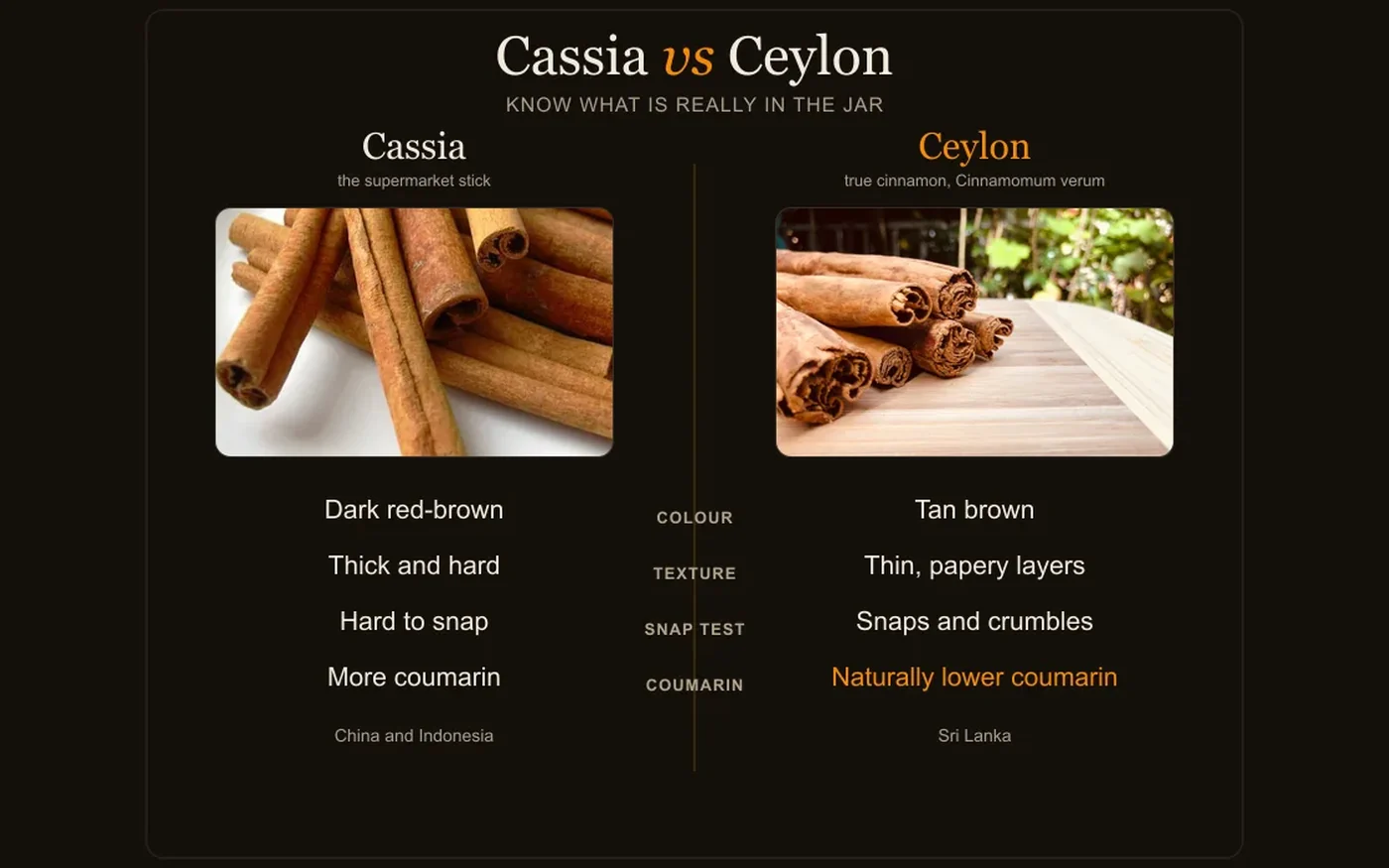
- Read the label. Look for “Ceylon cinnamon” or the botanical name Cinnamomum verum or Cinnamomum zeylanicum. If it just says “cinnamon” and is cheap, it is very likely cassia.
- Look at the sticks. Ceylon cinnamon quills are made of many thin layers rolled together like a cigar, and they are soft and tan-coloured. Cassia is a single thick, hard, dark curl.
- Taste and smell. Ceylon cinnamon is mild, sweet and citrusy. Cassia is bold and hot.
Buying from a source that tells you exactly what you are getting, and where it came from, takes the guesswork out. That is part of why we sell direct from our own estate.
The honest takeaway
The coumarin question is real, but it is not a scare story. Cassia in moderation is fine for most people; Ceylon cinnamon, being naturally very low in coumarin, is the sensible choice if you use cinnamon often. On top of that, Ceylon cinnamon simply tastes better in most dishes. So the better spice for everyday life happens to be the gentler one too.
If you would like to make the true cinnamon your everyday spice, ours is grown and hand-rolled on our family estate in Sri Lanka, never fumigated, naturally low in coumarin, and sold direct so the growers get a fairer share. Our Ceylon cinnamon powder and 50g sticks are an easy place to start. Use it often, with a clear conscience, and every purchase helps the families who tend the trees.
Sources: EFSA: coumarin tolerable daily intake · BfR: cinnamon and coumarin · Healthline: Ceylon cinnamon vs Cassia · NCCIH: Cinnamon
Taste the difference for yourself
Real Ceylon cinnamon, grown and hand-rolled on our family estate in Sri Lanka.
Shop the estate